Interview with Author of An Honorable Man
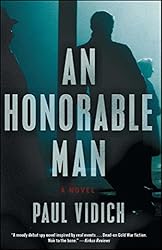
Chris Quarembo: What or who was your inspiration for creating the character of George Mueller? In some reviews, he’s described as a likable but reluctant spy. He’sdefinitely a loner and in your debut novel, An Honorable Man, Mueller says that “friendship is a dangerous luxury.”

Paul Vidich: Finding the voice for George Mueller, the protagonist in my first novel and the second, The Good Assassin, was key to unlocking each story. This character came to me through an abiding family tragedy that had sat unsettled in my mind for many years.
My uncle Frank Olson was a highly skilled Army scientist who worked at Fort Detrick in Frederick, Maryland, a top secret U.S. Army facility that researched biological warfare agents. He couldn’t talk to his wife about his work, and he couldn’t share his concerns with colleagues, who might question his loyalty. He was trapped in a moral maze. He died sometime around 2:30 am on November 28, 1953, when he “jumped or fell” from his room on the thirteenth floor of the Statler Hotel in New York City. He had gone to New York to see a psychiatrist in the company of a CIA escort. This was all the family knew about Frank’s death for twenty-two years.
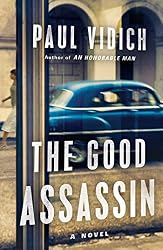
CQ: Your novels are set in the 1950s. An Honorable Man takes place during the McCarthy era in Washington, D.C. In The Good Assassin, you take readers to pre-Castro Cuba. What was your inspiration for this story?
PV: I was casting about for a character around which I could build my second novel when my wife handed me a New Yorker article about an American who played a small part in the Cuban Revolution in 1958. William Morgan was a U.S. citizen who led rebels of the Second Front that drove the Cuban army from key positions in the central mountains, helping Fidel Castro's forces defeat President Fulgencio Batista’s army.
Morgan was among two dozen U.S. citizens who fought in the revolution, and one of only three foreign nationals (another was Argentine Che Guevara), to rise to the army’s highest rank, comandante. I was intrigued by this man. Morgan’s short, tumultuous life inspired the character Toby Graham in the novel.
Morgan arrived in Cuba in December 1957 when Fidel Castro’s July 26th Movement had established itself as a small but effective opponent to Batista’s corrupt regime. Like many Americans, Morgan was drawn to Cuba after reading New York Times’ reporter Herbert Matthews’s front page account of meeting Castro in the Sierra Maestra Mountains and his romanticized description of the bearded six-foot tall revolutionary who was “an educated, dedicated fanatic, a man of ideals, of courage,” who had “strong ideas of liberty, democracy, and social justice.”
Morgan was a big, flamboyant man, who came of age in the Cold War, and like an earlier generation of young men who volunteered for the Republican cause in the Spanish Civil War, he wanted to make a difference in the world. He found his cause in Cuba’s struggle. Morgan served under Castro until he was accused of being a CIA spy. After a brief trial he was executed at dawn on March 11, 1961 in La Cabaña, the eighteenth-century stone fortress that overlooks Havana Harbor. He was thirty-two.
CQ: What will readers learn about George Mueller in your new novel that they didn’t know from reading your debut work?
PV: Mueller, a single man in the earlier novels, has married and has a child. He struggles with the tension between the secrecy of his job, and the openness that healthy family relationships require.
CQ: Your very favorable Kirkus Review states that An Honorable Man is noir to the bone. Do you agree with that analysis of your work?
PV: The tag line ‘noir to the bone’ has appeal, but it wasn’t how I thought of my writing. I had to reread the book to see what the reviewer referred to. I try to write elegantly and sparingly, except where the rhythm of a scene is served by longer sentences. I took it as a compliment.
CQ: What are you currently working on? Will there be another novel in the George Mueller series?
PV: The new novel is set in 1975. President Ford had assumed the presidency under the 25th Amendment in August 1974, when Nixon resigned, and the CIA complicity in Watergate turned Congress against the Agency. The book is set in this tumultuous year – Saigon falls in the Spring, Ford struggles with popularity, the CIA is demoralized.
CQ: What books are you currently reading?
PV: I read widely. My to-read stack includes Joseph Kanon’s new book, Defectors, Richard Lange’s new book, The Smack, and Shakespeare’s play, Measure For Measure, a brilliant play about justice and mercy.
CQ: Do any books stand out over the years as being inspirational for your own writing?
PV: Jane Eyre by Charlotte Bronte’s is a remarkably confident work. Le Carre’s The Spy Who Came in From The Cold, ushered in a new chapter is espionage fiction. Eric Ambler’s A Coffin For Dimitrios is required reading for anyone interested in good writing and strong story telling. It had a big influence on Graham Greene, whose book, The Quiet American, is also a favorite of mine.
CQ: When you’re not writing, what do you enjoy doing?
PV: My wife and I go to the theater a great deal. I am an angel investor in technology startups, which require some time, and I have two grandchildren who I help care for on weekends.
